I ran the financial model, partner operations and pilots for a tool-financing venture in Kenya and Nigeria, then managed repayments, refunds and settlement when the mandate ended.
My role
Lead, Nigeria & Kenya · BNPL
Live markets
Kenya & Nigeria
Stage
Pilot validation → closure
83Customers financed
2Live credit markets
Sep 2024Settlements signed
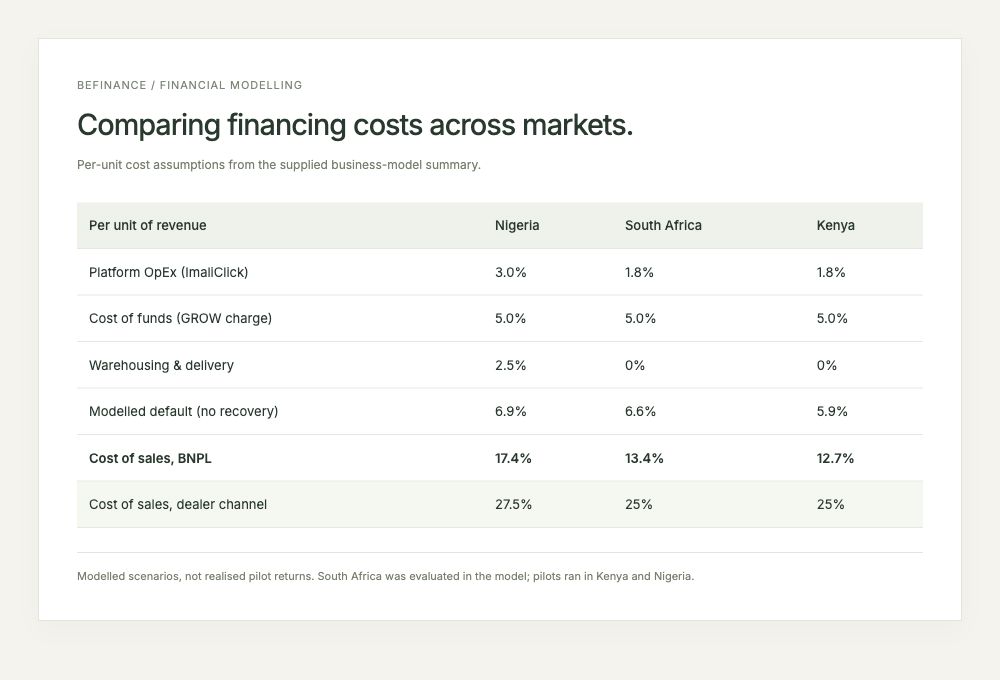
The financing model was a working tool for the pilot. This excerpt shows assumptions, not realised returns. View full size ↗
01 / The assignment
Could artisans repay a tool from their earnings?
BeFinance tested a way for informal artisans to buy Bosch power tools without a conventional credit history. Customers paid a deposit, received the tool and repaid the balance in instalments. A social guarantor supported each application.
I took over as BNPL Lead for Nigeria and Kenya in May 2023. I owned the financial model, partner operations and pilot delivery in Kenya and Nigeria, then managed the wind-down after the validation mandate ended. Bosch Power Tools supplied the products; GROW provided the financing buffer; ImaliClick operated the payment platform.
The work involved more than getting credit into customers’ hands. We needed a collection process, limits on exposure, country approvals and a way to settle the accounts if the venture stopped.
02 / Decision one
Launch in Kenya and Nigeria; stop the South Africa launch.
Three markets had signed platform agreements, but only two issued credit. Expert interviews and early field feedback in South Africa pointed to established credit alternatives and a financing offer that would struggle to compete. Bosch also lacked the direct-sales invoicing setup the pilot needed.
The South Africa launch was stopped before issuing credit. That kept the team focused on the two markets where we could test the offer through existing customer channels. A signed agreement was not sufficient reason to launch.
In Nigeria, recruitment ran through trade associations and market activations. In Kenya, the team worked through TVET colleges, with trainers and heads of department acting as guarantors. We adapted distribution and guarantors to each market while keeping the financing rules comparable.
03 / Decision two
Use a payment partner while Bosch retains credit decisions.
I compared a custom M-Pesa workflow, an existing financing provider and a partner-operated platform. Building our own workflow would have added credit operations and licensing questions before demand was established. The existing provider evaluated with dealers did not fit the offer: customers would receive their tool only after full repayment.
ImaliClick supplied identity checks, customer accounts, reminders, payments and reconciliation. Bosch retained the customer agreement and credit decisions. This gave us the operating functions needed for a pilot without committing to a proprietary platform.
The trade-off appeared in collections. Repayment still depended on customers responding to reminders; we could not automatically deduct money when it entered their wallets. The team moved from a single reminder before maturity to weekly follow-up.
04 / Decision three
Model the cash exposure before issuing credit.
I co-built and then owned the financing simulation. It tracked customer cohorts, deposits, repayment periods, defaults and upgrades in local currency. We used it to compare the financing channel with dealer sales and to understand how much cash each market would tie up.
The offer required a 30% deposit, with repayment over one to four months depending on the tier. Controls included one active plan per customer, guarantor limits, identity checks and approval for tier upgrades. These reduced exposure; they did not eliminate fraud or default.
Volume mattered. The model projected lower costs per financed tool at scale, but the platform’s minimum fee made pilot-scale operations expensive. A modelled margin was not a realised pilot profit.
Model assumptions and operating controls
Scenario inputs included funding cost, platform fees, delivery costs, default and recovery rates. Stress tests examined how higher default would change cash requirements. Each market ran in local currency, so exchange-rate assumptions also affected the comparison.
Buffer released gradually, with withdrawals restricted to Bosch accounts.
Customer identity checks and a cap on applications per guarantor.
Country approval for tier upgrades and monthly bank reconciliations.
Fixed settlement dates and a process for returning unused funds.
These assumptions need to be read with the full model. They do not establish realised margin or profit.
05 / Results
83 customers financed across two live markets.
Pilot results reported in the project records
Market
Customers financed
Default at close
Recruitment channel
Kenya
37
0%
TVET colleges
Nigeria
46
7.15%
Trade associations and market activations
Both reported default rates were below the pilot’s 10% risk hypothesis. The two groups differed in recruitment, guarantors and operating conditions, so the comparison does not establish that one guarantor model caused the lower default rate.
The pilots showed that customers would take up the offer and that the team could operate repayments through a partner. They did not establish profitability at scale. Wider distribution, recurring operating costs and collections would still need testing.
06 / Closure and lesson
Collect repayments, return unused funds and sign settlements.
New credit stopped when the validation mandate ended. Collections continued while I consolidated transactions, reconciled balances and arranged refunds of unused financing buffers. Bosch country leadership and the partner signed the settlement statements in September 2024.
My main lesson was operational: a repayment channel is part of the product. Our partner could process payments, but the pilot team still had to collect them. I would make collection effort and payment control explicit in the next financing model, alongside default and acquisition costs.
The close also showed the value of agreeing settlement responsibilities before launch. It gave the team a defined route for returning funds and closing the customer and partner accounts.
Working on a similar decision?
Tell me about the venture, the market and the question you need to answer.