Legal Research AI / Bosch Business Innovations / 2024
Testing how lawyers would use and trust AI research.
I led customer discovery and two prototype iterations for a legal-research venture, turning practitioner feedback into requirements for sources, citations and information access.
My role
Innovation Lead & Venture Architect
Team
7–10 across legal, product & engineering
Stage
Discovery → tested prototypes
9Discovery & experiment sessions
2Prototype iterations
~6 monthsValidation cycle
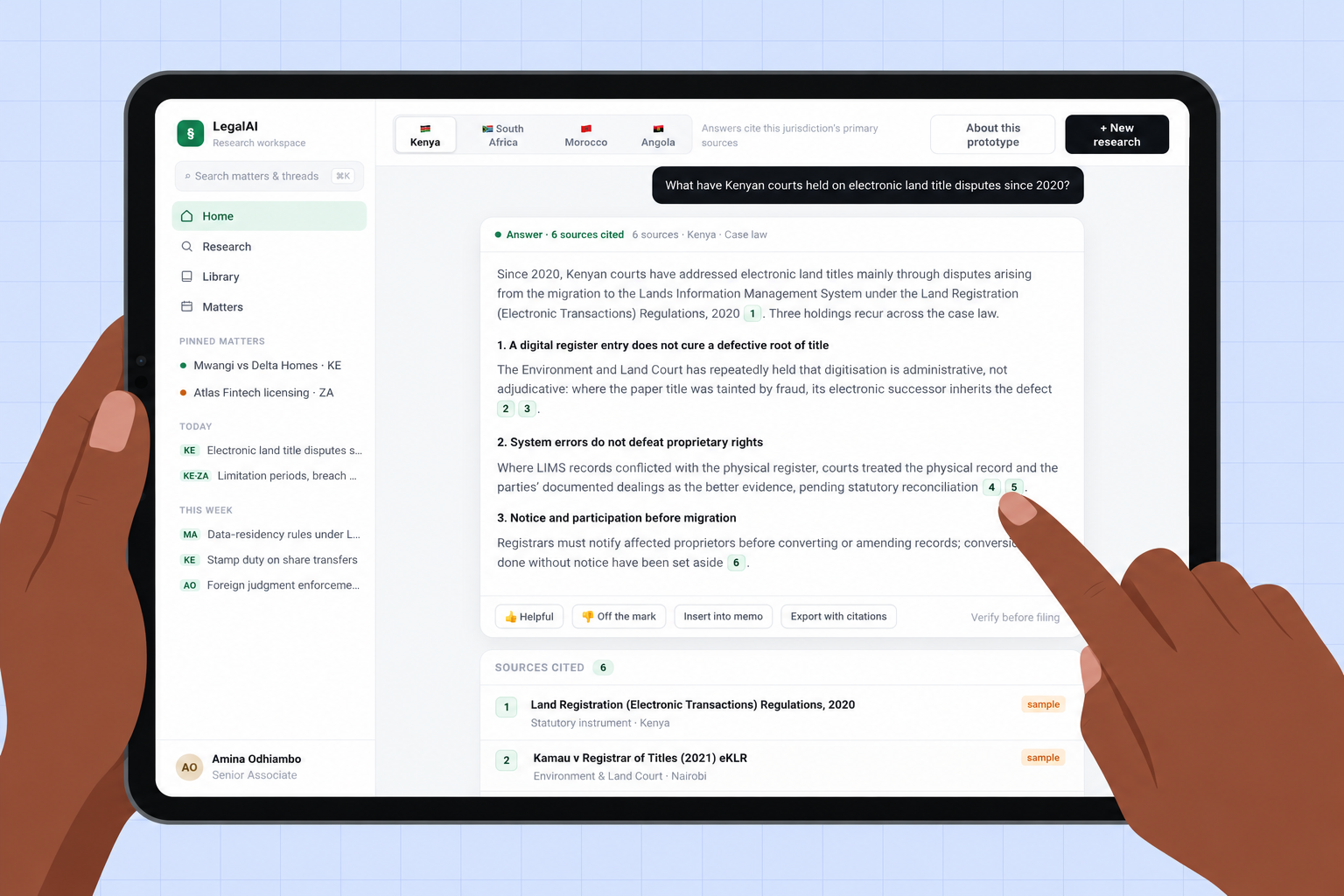
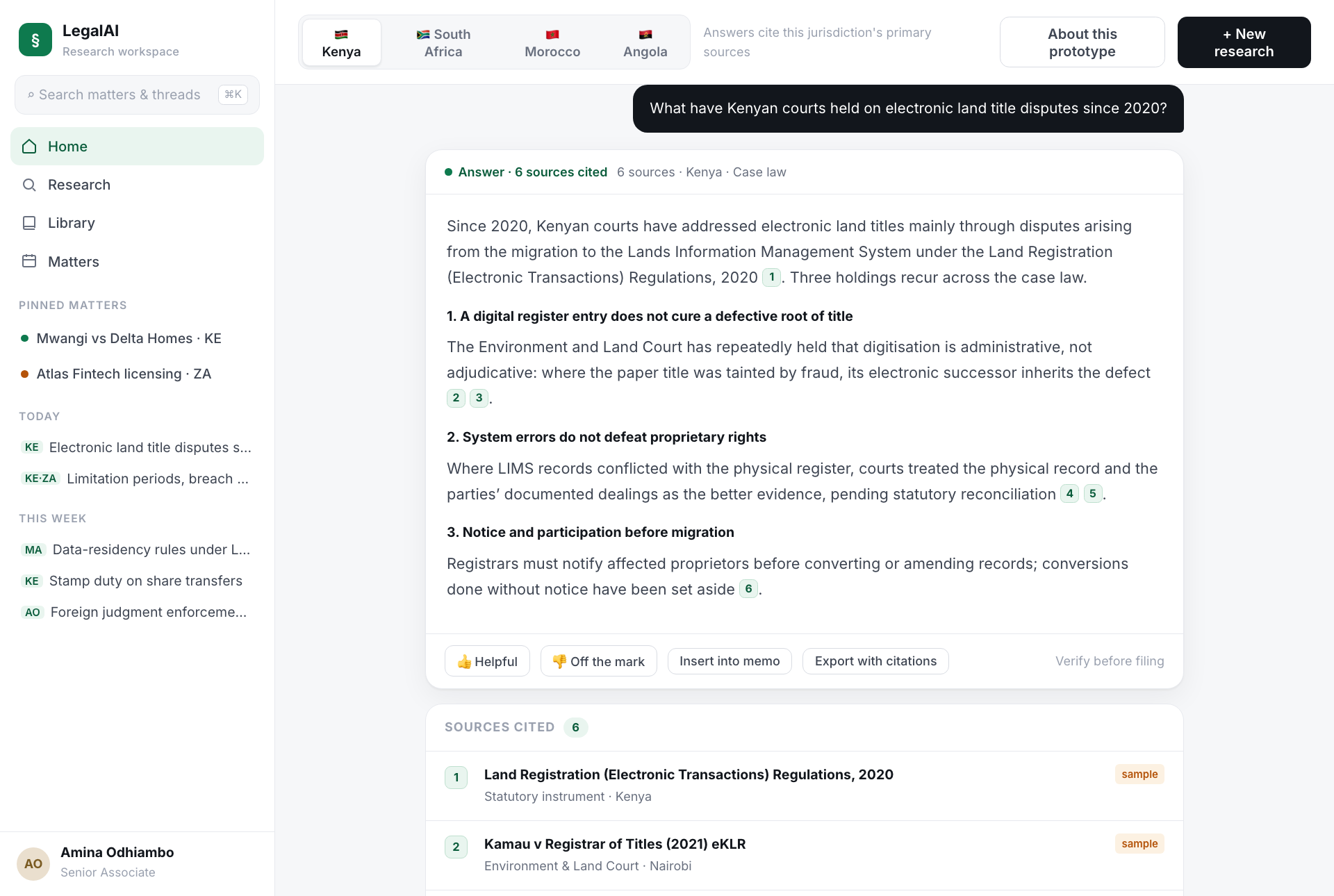
Cover illustration of the proposed citation-review experience. Original research artefacts and an unframed prototype reconstruction follow below. View full size ↗
01 / The assignment
Understand where AI could help lawyers.
Lawyers assembled answers from legislation, case law, paid platforms and internal knowledge. The venture explored whether a shared research tool could reduce that effort while keeping the source and jurisdiction clear.
I led a team of 7–10 across legal, product and engineering through roughly six months of discovery and prototype testing. The brief covered four jurisdictions: Kenya, South Africa, Morocco and Angola. My responsibility was to define the customer problem, prioritise assumptions and decide what the team should test before a production build.
I used the Testing Business Ideas approach to organise the work. Interviews and workflow observation shaped the problem; clickable prototypes tested how participants understood and used the proposed experience.
02 / Decision one
Observe recent legal-research tasks.
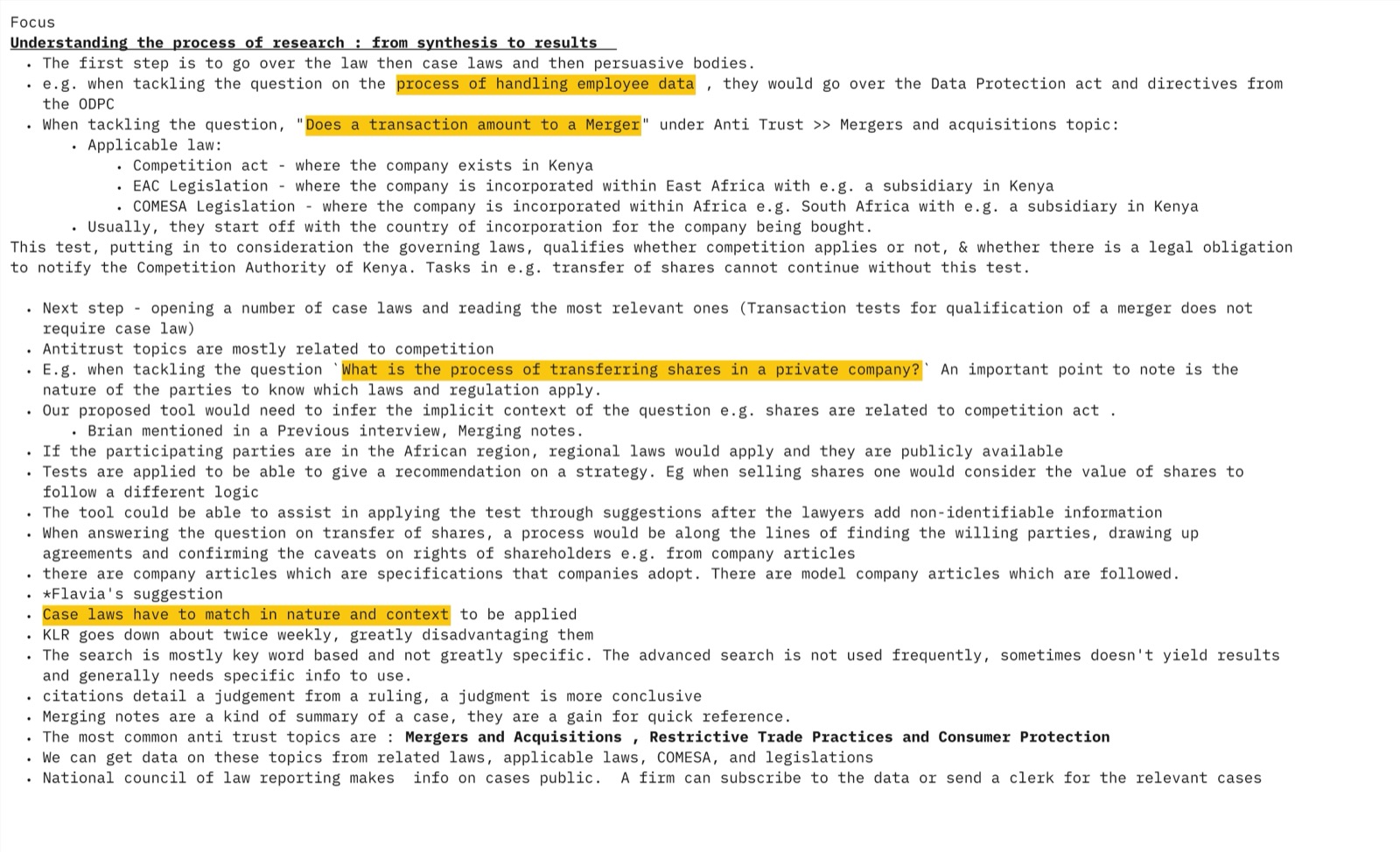
I asked internal counsel and external practitioners to walk through recent research and drafting tasks. An experience day at CDH helped us observe how an initial question became a search, a set of sources and an answer.
The useful details were practical. A legal source had to match the jurisdiction and the nature of the matter. Lawyers wanted to know which court a case came from and how later decisions had treated it. Internal documents also raised questions about permissions and client confidentiality.
Those findings changed the brief. The product needed to help lawyers inspect and assess sources, rather than simply return a fluent answer.
Discovery artefact: observing the research process gave us specific questions to carry into prototype testing. View full size ↗
03 / Decision two
Keep the lawyer responsible for the final judgement.
Discovery suggested starting with repeatable research and drafting tasks, including routine agreements. I kept complex advisory judgement outside the initial automation scope. That gave the team a narrower workflow to explore.
One stakeholder described a useful draft as contributing about 70% of a document, leaving the remaining work to a lawyer. I treated that as a design direction, not a measured level of automation.
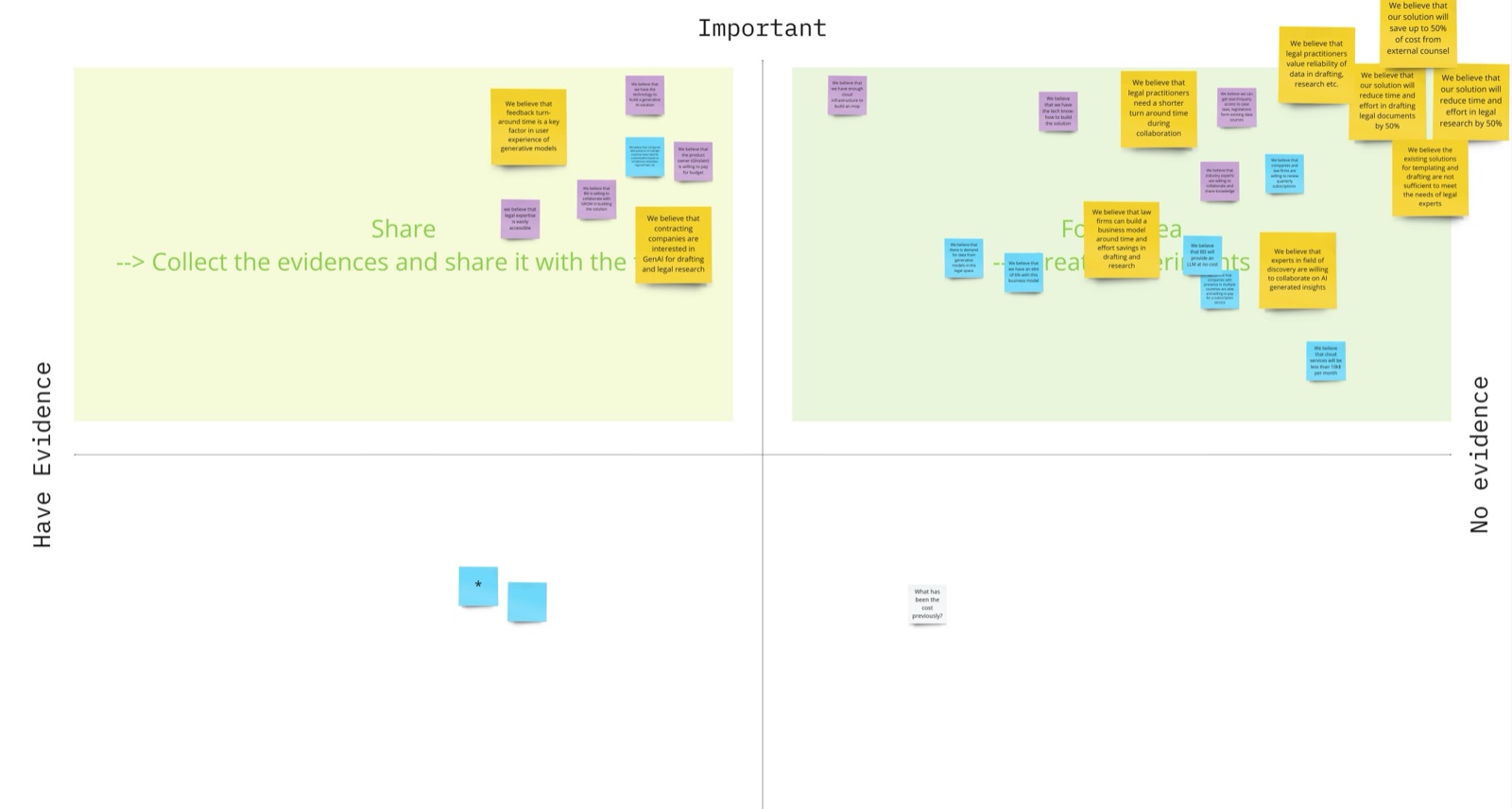
I prioritised assumptions by importance and the evidence available. Would lawyers trust the sources? Could they check the answer? Could sensitive information be kept within the right permissions? Cost and time-saving claims remained hypotheses until a later test could measure them.
View the assumptions map
Working prioritisation map. Its time- and cost-saving statements are assumptions, not measured outcomes. View full size ↗
04 / Decision three
Make citations and source checks part of the workflow.
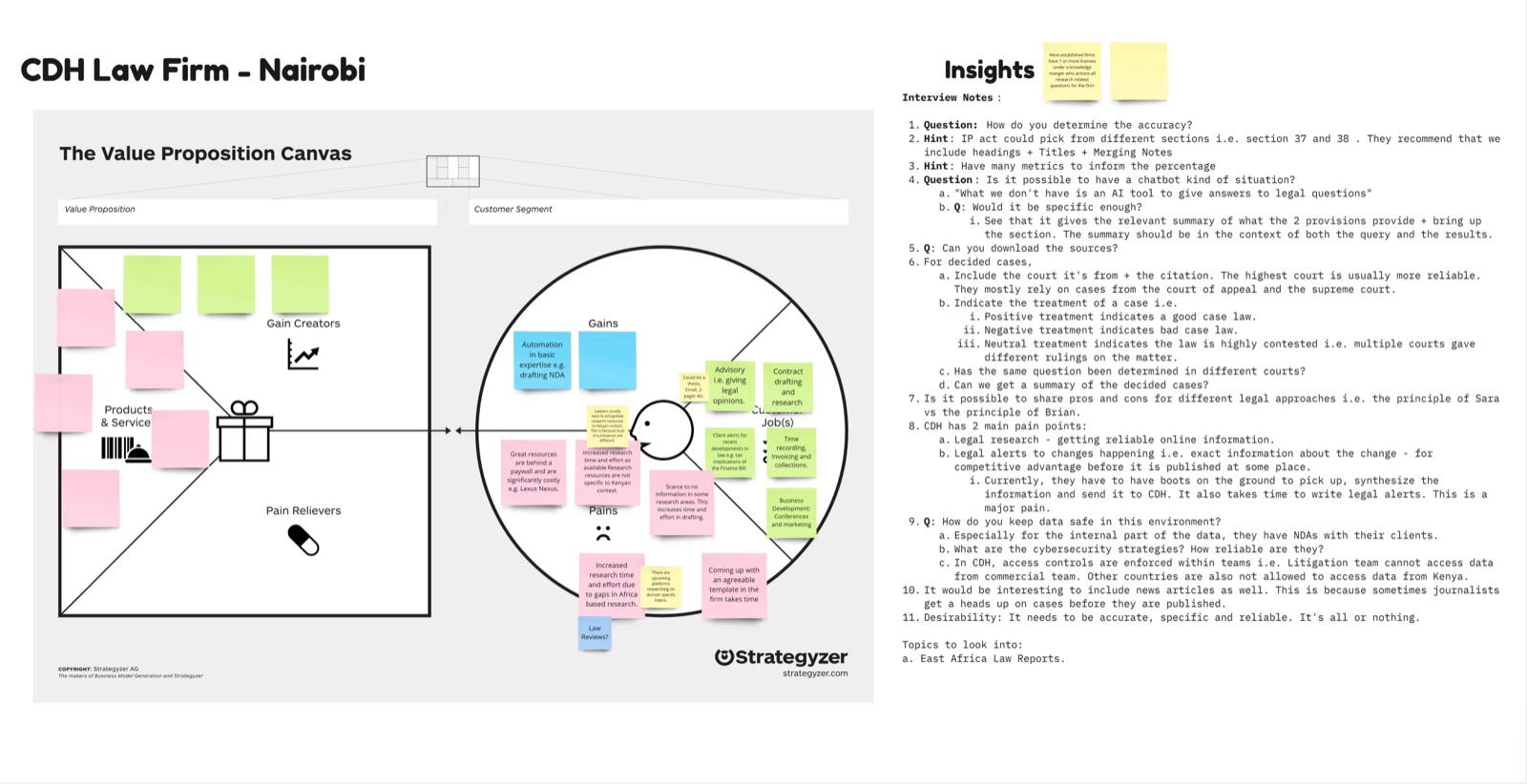
Two prototype iterations let us test the proposed experience with practitioners before committing to production engineering. Feedback asked for source downloads, court identification, case treatment and access controls. Those are requirements a general chat interface would not make obvious.
I used the sessions to refine what the product should show and what needed a separate technical test. A participant understanding a clickable answer screen does not establish that an AI model can retrieve the correct law or produce an accurate answer.
Prototype feedback: participants asked how accuracy would be determined, whether sources could be downloaded, and how confidential information would be protected. View full size ↗Illustrative reconstruction of the proposed citation-review workflow. The original research notes above document the participant feedback. View full size ↗
Continue development, with accuracy and demand still to test.
The project completed nine discovery and experiment sessions and two prototype iterations. The team chose to continue development with clearer requirements for citations, local context and information access.
The work supported the relevance of the problem and gave us feedback on the proposed workflow. It did not establish production accuracy, paid demand or sustained use. Those required a functioning system and a different kind of test.
Prototype measurement notes
Project records included a 90% internal prototype-fit score and a 50% time/cost improvement estimate. The scoring method, sample and baseline are not available in the public case. These figures remain prototype-stage indicators. Neither establishes commercial product-market fit or production performance.
The lesson I would carry forward is specific: source inspection belongs inside the research flow. Users needed a way to judge an answer, including its jurisdiction, court and supporting material. That requirement should shape both the interface and the technical evaluation.
Working on a similar decision?
Tell me about the venture, the market and the question you need to answer.