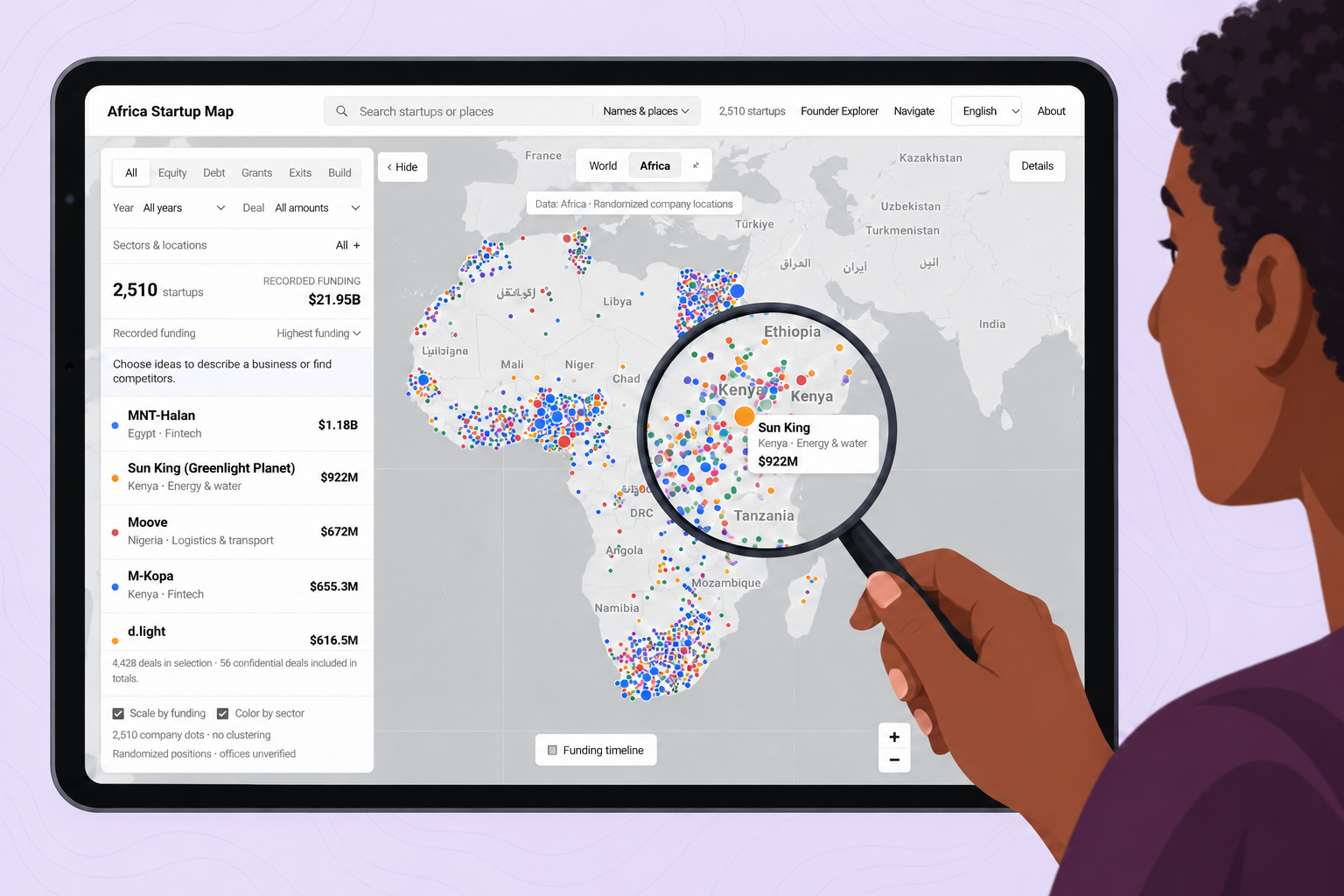
Cover illustration. The walkthrough below uses captures of the live product. View full size ↗
01 / The assignment
Make a large funding dataset usable for research.
I founded Chancery to work on startup validation and market-entry questions. Africa Funding Atlas is the research product I built within that venture: an interface for finding companies, narrowing a market and inspecting recorded funding.
The underlying records covered thousands of companies and funding events. I wanted users to move from a broad question to a company worth investigating without working through the entire dataset. I owned the product scope, interface and build.
02 / Decision one
Offer a company list alongside the map.
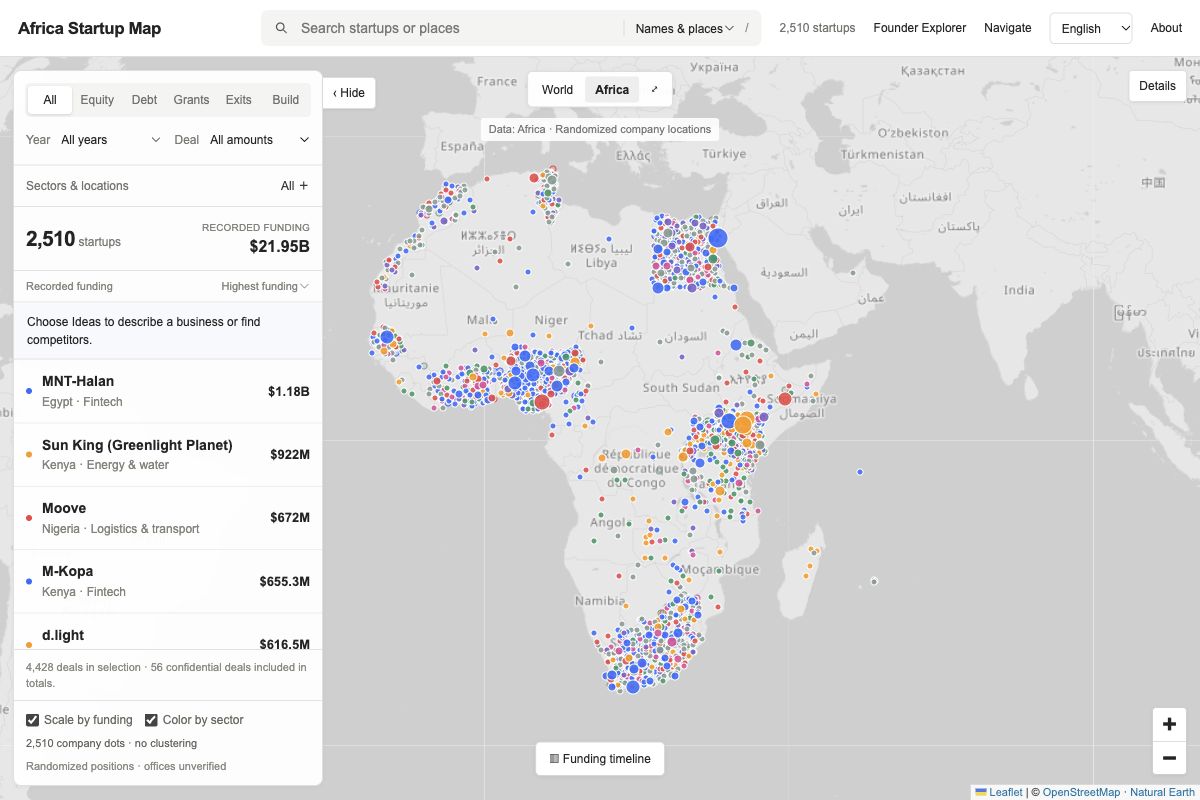
The map gives geographic context, but researchers also need names, sectors and amounts they can compare. I paired it with a sortable directory and filters for country, sector, year, funding category and deal size.
This supports a defined task: find companies in a market, inspect their recorded funding and choose which ones need further research. It does not assume that the largest funding total identifies the best company.
Live product capture, October 2026. The directory keeps company names and recorded amounts visible alongside the map. View full size ↗
03 / Decision two
Keep the recorded funding history accessible.
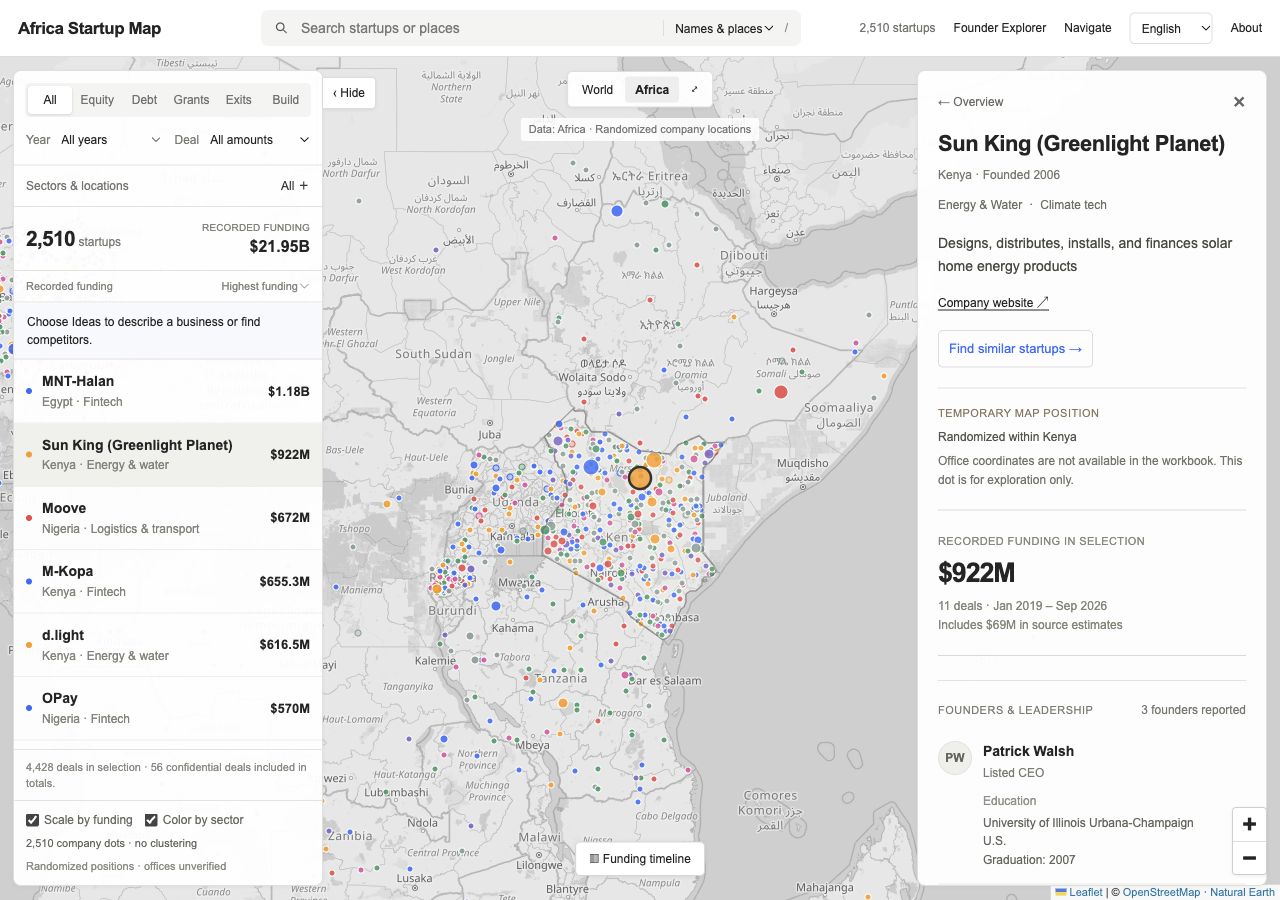
A company total is only a starting point. Opening a company shows its profile and funding history within the active selection, including dates, funding types and any source-estimate flag.
For example, the Sun King record in the October snapshot reports $922M across 11 deals and flags $69M as a source estimate. A researcher can inspect the individual entries rather than treat the headline total as independently verified.
Actual company-detail view captured in October 2026. The profile exposes the estimate notice and a scrollable funding history. These are dataset records, not independently verified company financials. View full size ↗
Narrow the search. Choose a geography, sector or company name.
Open a company. Review its description and recorded funding within the selection.
Inspect the entries. Check dates, funding types and estimates before using the figures in a research brief.
04 / Decision three
Make the data limitations visible.
Funding raised, company valuation and customer demand answer different questions. I kept funding categories visible and separated exits from the funding view. Map positions are randomised within source geographies because office coordinates are not available.
Idea-based search offers another route to discovery when a user has a business description rather than a company name. Its matches are leads to inspect, not a complete competitor set. Founder Explorer provides a separate view of founder profiles.
Coverage and method: October 2026 snapshot
The all-years funding view reports 2,510 named startups and 4,428 deals covering January 2019–September 2026. The project methodology refers to a 4 October workbook snapshot with 4,679 records, including 251 exit/M&A records excluded from funding.
Source estimates are included and other amounts have not been independently verified. Different capture thresholds across years limit raw year-on-year deal-count comparisons. Map dots do not establish office locations.
Idea search uses a locally hosted MiniLM model, with queries processed on the visitor’s device. Its results are approximate discovery matches.
05 / Results
A live research product; usefulness is the next test.
The product is available to use. The dataset counts describe coverage, not traction: this case does not yet evidence paying customers, revenue or measured time savings.
My next validation step is to observe founders, corporate innovation teams and researchers completing the same defined task: build a shortlist for a country and sector, then explain the records behind it. I would measure whether they can complete the task, where they need help and whether the result is useful enough to use again.
The lesson from this build is that exploration and verification need to work together. A map can help someone find a company; the funding record must give them enough context to decide what to investigate next.